Showing posts with label BIOGRAPHY. Show all posts

History of K2 mountain Biography-K2 highest peak in the world by Umair Ahmad

July 27, 2021

History of K2 mountain Biography-K2 highest peak in the world by Umair Ahmad
K2
History of K2 mountain Biography-K2 highest peak in the world by Umair Ahmad 

K2:-

K2 is the second highest peak in the world. This range is located in Karakoram Mountain, Pakistan. Its height is 8611 meters / 28251 feet. It was first climbed on July 31, 1954, by two Italian climbers, Lesdale and Companioni. It is also called Mount Goodwin Austin and Shahguri.

History of K2:-

The mountain was first surveyed by Goodwin Austin in 1856. Thomas Mount Gumri was also with him. It was named K2 because it was the second highest peak in the Karakoram Range. It is named after Godon Austin. The first expedition to K2 took place in 1902 and ended in failure. After that, the efforts of 1909, 1934, 1938, 1939 and 1953 also failed. The Italian campaign of July 31, 1954, finally succeeded. Lisdale and Companioni managed to climb the K2. 23 years later, in August 1977, Achiro Yoshizawa, a Japanese climber, managed to climb it. With him, Ashraf Aman was the first Pakistani to climb on it. In 1978, an American team managed to climb it. K2 is considered more difficult and dangerous than Mount Everest. There are 246 people on K2 and 2238 on Mount Everest.K2 or Godon Austin Peak is the highest peak in the Karakoram Range in Gilgit-Baltistan, near the Pakistan-China border. It is the second highest peak in the world after Mount Everest. Cato is also called Chhoghori in the local Balti language, who cries out to the climbers at an altitude of eight thousand six hundred and eleven meters, or twenty-eight thousand two hundred and fifty feet above sea level, with all her murderous rage. Thomas Montgomery climbed the peak when a survey was conducted under the British government to measure the dimensions of India. Named after (Karakoram 2). Earlier, Henry Godon Austin, an English geologist, had discovered this crown of Karakoram. For this reason, it is also called Mount Godon Austin. This highest peak of Mount Karakoram is also called a savage or cruel mountain peak due to its dangerous ascents and slopes. Cato-climbing rates are lower than Mount Everest because of the extremely unfavorable weather and the deadly climb of the mountain whose lines are almost vertical. More climbers have died. In these climbs, 'Bottleneck' is the most dangerous place where many fatal accidents have taken place. These include the 2008 Kawa tragedy in which 11 climbers from different countries lost their lives. Bottleneck K2 is the general who is equipped with pillars and towers of the giant temple of ice and deceitfully kills one out of every five climbers who climb this pyramid-like mountain peak. That is why it is said that K2 is the peak that distinguishes between a passionate climber and a fame-hungry climber. The first attempt to head Cato was made in 1902 but failed. After the failures and experiments of several mountaineering groups, in 1954 an Italian team added a golden chapter to the history of mountaineering by climbing the brutal peak of K2 for the first time. In 1977, Ashraf Aman became the first Pakistani to conquer K2. Since then, many climbers have managed to reach the highest point of the Karakoram. June to August are the best months to climb K2. The rest of the year the weather here is very unsuitable for mountaineering. The most common route used to head it is the Abruzzi route, which is a difficult and dangerous route to use on a technical basis. Nazir Sabir is the proud capital of Pakistan who made a historic achievement by leading K2 to Western invasion. The 1981 mountaineering featured a Japanese climber with Nazir Sabir. Mehraban Shah, Rajab Shah and Hassan Sadpara have also reached the heights of K2. In 2014, for the first time, a team of Pakistani barriers and guides stepped on top of K2 with Italian climbers to celebrate the 60th anniversary of its ascent. The K2 was first filmed by a drone in 2016, but it was only possible up to 6,000 meters, after the K2's guard weather refused to allow the drone to fly.

Osman Ghazi - Usman Ghazi - One of the biggest Empire - Ottoman Emipe

January 08, 2021

Osman Ghazi - Usman Ghazi - One of the biggest Empire - Ottoman Emipe

Osman I

Usman Khan Ghazi (Usman bin Artagharl, Usman I or Usman Khan Ghazi) (Ottoman Turkish: Usman Ghazi) (born 1258 - died 9 August 1327) was the founder of the Ottoman Empire.

Autonomy

Osman Ghazi - Usman Ghazi - One of the biggest Empire - Ottoman EmipeAfter the death of Uthman's father, Ertugrul, the Mongol occupation of Konya, the capital of the Roman Empire, and the fall of the Seljuk Empire, Uthman's estate became independent, later called the Ottoman Empire. Usman Khan's estate was bordered by the Byzantine Empire of Constantinople. This was the same Byzantine government known as the Roman Empire in Arab times, which was taxed by the Seljuks in the time of Alp Arsalan and Malik Shah. Now this Byzantine Empire had become very weak and small The competition was huge and powerful. The Byzantine forts kept invading Usman's manor, which led to fighting between Usman Khan and the Byzantine government. Uthman showed great bravery and ability in these battles and conquered many areas, including the famous city of Bursa. Uthman died after the conquest of Bursa.


the role

Uthman was a very brave and wise ruler. He used to do justice to his subjects. His life was simple and he never amassed wealth. He used to distribute the booty among the soldiers after taking out the share of the orphans and the poor. He was generous, compassionate, and hospitable, and it is because of these qualities that the Turks still hold him in high esteem. After that, it became customary that when a king sat on the throne, Uthman's sword was tied around his waist and it was prayed that God would create in him the same qualities as Uthman. Usman's capital was his city, but after the conquest of Bursa it was declared the capital.

Dream

Uthman had a dream that:

"A huge tree appeared from its side which continued to grow. Until its branches spread over the sea and the sea. Out of the root of the tree flowed 4 great rivers of the world and 4 great mountains to its branches. Then a strong wind blew, and the leaves of this tree turned towards a great city, which was a place where two seas and two continents met and looked like a ring. Usman wanted to wear the ring when his eye was opened.

Osman Ghazi - Usman Ghazi - One of the biggest Empire - Ottoman Emipe
This dream of Uthman was considered very good and later people interpreted it as 4 rivers were Tigris, Euphrates, Nile and Danube and 4 mountains were Mount Tur, Mount Balkan, Mount Qaf and Mount Atlas. Later in the time of Uthman's descendants, as the empire spread to these rivers and mountains, this dream was in fact a prediction about the size of the Ottoman Empire. City means the city of Constantinople which Uthman could not conquer but later conquered. After 'Uthman, his descendants became great kings who made his dream come true. In the history of Islam, the rule of any family has not lasted as long as the rule of Al-Uthman and no ruler has been born in a family as capable as Al-Uthman. 

Ibn-e-Sina Biography - History--Bo Ali Ibn-e-Sina (Avicenna)

April 13, 2020

Ibn-e-Sina Biography - History--Bo Ali Ibn-e-Sina (Avicenna)

Ibn-e-Sina:

Ibn-e-Sina Biography - History--Bo Ali Ibn-e-Sina (Avicenna)Bo Ali Sena's full name is Ali al-Hussein ibn Abdullah ibn Hussein ibn Ali ibn Sina (980 - 1037 AD), a prominent physician and philosopher of the world. Ibn Sina or Abina Sina was a learned scholar of Persia who is considered among the most important thinkers and writers of the golden age of Islam during the time of Aaron al-Rashid. Abu Selina is known in the West as Avicenna. His title is "Al-Shaykh al-Raees". Was one of the greatest thinkers of Islam and one of the most famous philosophers and practitioners of the East. He is thought to have authored 450 books, out of which around 240 survived, of which there were 150 on philosophy and 40 on medicine. His most famous books include "Book Healing, a Philosophical and Scientific Encyclopedia and the" Medical Laws of a Medical Encyclopedia. "Many of these items were available in medieval universities until 1650 as a standard medical book. In 1973, Ibn Sina's book "Medical Laws" was reprinted in New York. In addition to philosophy and medicine, Ibn Sina also studied astronomy, chemistry, geography and geology, psychology, Islamic theology, logic, mathematics, physics. Ibn Sina is also called the sun of the medical world.

Biographies:

Bo Ali Sina initial conditions:

Zero 370 AH was born in 980 in a small village in Persia, in 980, his mother belonged to this village, while his father came from Balkh (present-day Afghanistan). In early childhood, his parents moved to Bukhara (present-day Uzbekistan), where his father was entrusted with some financial affairs of Sultan Noah bin Mansour Al-Samani. Bukhara completed the Quran at the age of ten and excelled in the pursuit of jurisprudence, literature, philosophy and medical sciences and achieved excellence in them.

Living conditions:

Sultan Bukhara Noah ibn Mansoor became ill. A regimen's medicine was not proven to be effective. At the age of eighteen, he treated Sultan Noah ibn Mansour for a disease which had caused him to be paralyzed. Sultan recovered from the medicine of an inferior and renowned physician like Ibn Sina. So the Sultan gladly opened a library for them as a reward. He lived in Bukhara until he was twenty years old, and then moved to Khwarizm, where he stayed for some ten years (392 AH-402 AH). Became attached to the court, as if he had spent the rest of his life traveling.

Last day:

He died in Shaman 427 AH in Hamdan in 1037 AD. It is said that in the last days of his life he had succumbed to cholera, and when he saw his near death, he bathed and repented, gave his wealth and freed the slaves.

Release of academic services and highlights:

Bo Ali's memory was very sharp. Soon Sultan Noah Bin Mansoor checked the library and collected all the information. At the age of twenty-one, he wrote the first book. According to a tradition, Bo Ali Sina wrote twenty-one large and twenty-four small books. Some think he wrote ninety books.

Muhammad bin Qasim Biography - History Realty Muhammad Bin Qasim

April 13, 2020

Muhammad bin Qasim Biography - History Realty Muhammad Bin Qasim

Muhammad bin Qasim:

Muhammad bin Qasim Biography - History Realty Muhammad Bin QasimMohammed bin Qasim's maiden name was Emaduddin Mohammed bin Qasim, the nephew of Hajjaj bin Yusuf, a renowned soldier of the Umayyad. Muhammad bin Qasim conquered Sindh at the age of 17 and introduced Islam to India. Because of this great victory, they have the honor of being a Christian among the Muslims of India and Pakistan and that is why Sindh is called "Bab-ul-Islam" because the door to Islam opened on India. Mohammad Bin Qasim was born in 694 AD in Taif. His father was counted among prominent family members. When Hajjaj ibn Yusuf was appointed governor of Iraq, he appointed prominent members of the cultural family in various positions. Among them was Mohammed's father Qasim, who held the governorship of Basra. This is how Muhammad bin Qasim's initial training took place in Basra. His father passed away at the age of about 5.

Early period:

From his childhood, Mohammed bin Qasim looked like a wise and capable man of the future. Due to poverty he could not fulfill his desire to pursue higher education so after primary education he joined the army. He was trained in the art of soldiery in Damascus and gained the highest rank in the army because of his talent and extraordinary ability at a very young age. At the age of 15, 708 was entrusted with the duties of a soldier to end the Kurdish uprising in Iran. At that time, the ruler of Bani Umayyad was in the era of Walid bin Abdul Malik and Hajjaj bin Yusuf was governor of Iraq. In this campaign, Mohammed bin Qasim succeeded and made Shiraz a special city, a modest camp. In the meantime, Muhammad bin Qasim was made governor of the Persian capital Shiraz. Created and sent.

The establishment of the family Abu Bakr:

The pilgrims abolished the rule of Abdullah bin Zubair, the grandfather of Hazrat Abu Bakr in Mecca, and his body would be hung at the mosque for recitation. Then he went to Iraq and crushed the rebellion of Hazrat Abu Bakr's nephew, Abdul Rahman bin Mohammed bin Al-Asha. He was accompanied by renowned narrator and Hadith teacher Atiyah ibn Saad Awfi. He was old enough, but after the failure of the coup, fled Kufa to Iran. In Shiraz, Mohammed bin Qasim arrested the donor. Hazrat Ali, who started in the time of Hazrat Mu'awiya during this period, still had the tradition of reconciliation. Consequently, Hafiz ibn Hajar Esqalani, in civilization, Ibn Sa'ad in classics and Ibn Jarir Tabari in history classics, writes:

"Hajjaj ibn Yusuf wrote to Mohammed bin Qasim demanding Hazrat Atiyah ibn Sa'ad al-Awfi to demand that all be reconciled to Hazrat Ali and if he refused to do so, he would be whipped with four hundred whips. Mond Dey - Muhammad Bin Qasim called him and demanded that all be reconciled to Hazrat Ali. If he refused to do so, Mohammed bin Qasim shaved his beard and put four hundred whips on him. Khorasan is gone. He is a trusted narrator of Hadith. "

Infidelity:

In Oman, Mu'awiyah bin Harith Alafi and his brother Mohammed bin Haris Alafi rebelled against the Caliph in which Amir Saeed was killed. Was. One of the reasons behind Muhammad bin Qasim's attack on Sindh was to arrest them. In addition to this, the expansion of the Umayyad Empire and the establishment of trade routes were the reasons for the attack. According to a tradition, when the king was arrested by the Chand Chand women who came with the merchants, Muhammad Qasim attacked Sindh.

Victory Sindh:

At the age of 17, he was sent as an advisor on the Sindh campaign. The conquest of Muhammad bin Qasim began in 711 and continued until 713 AD. They conquered important areas of Sindh and conquered Multan and brought the conquests of Sindh to an end. Muhammad Bin Qasim was a lesser figure, but in this short Sunni he not only made a name for himself as a great conqueror but also proved to be a successful administrator. He spent about 4 years in Sindh, but in this short period he managed the empire with victories and laid the foundation of a system of government in Sindh that fulfilled all the requirements of justice. The achievements of Muhammad Bin Qasim in India because of his abilities, courage and good demeanor are remarkable. He adopted a great tolerance policy for the people of Sindh. Muhammad Bin Qasim's victory in Sindh had numerous influences in every respect, political, social, religious and practical.

After Muhammad Mohammed bin Qasim:

Muhammad bin Qasim lived in Sindh for about 4 years. After the conquest of Sindh they governed the system very successfully. The success of this system was, of course, his personality. He was ousted from the Sindh Governor and Yazid bin Abi Kabasha was appointed governor, but he died a few days later. By the time of his death and the arrival of the new governor, the effects of the arrest of Muhammad bin Qasim began to appear in Sindh.

Camera inventor Ibn al-Haytham - A great Muslim Scientist Ibn-e al Hasim (Haytham)

April 05, 2020

Camera inventor Ibn al-Haytham - A great Muslim Scientist Ibn-e al Hasim (Haytham)

Ibn al-Haytham:

Camera inventor Ibn al-Haytham - A great Muslim Scientist Ibn-e al Hasim (Haytham)His name is "Abu Ali al-Hassan ibn al-Haytham", known as Ibn al-Haytham. Ibn al-Hashim (born 965, died 1039) was born in Basra, Iraq's historic city. He was a prolific researcher in the fields of physics, mathematics, engineering, astronomy and physics. The reason for this is due to fame eyes and light investigations.
His 237 books have been counted in various fields of science. His famous book is "Book of the View". In addition, he also made Camera the first time. Writing commentary and commentary on Muhammad al-Farsi's Ibn al-Hathom, the book, which had been ignored by the Middle East, has been highlighted and translated into Europe. This book by Mohammed Al Farasi is written in Arabic al-Taqiqah and Tanqih in English.

Biographies:

Initial conditions:

He was born in the Iraqi city of Basra, probably in 354 AH and died in 430 AH. He went to Egypt and remained there until his death. From his childhood he was accustomed to meditation. He was very interested in teaching and writing. Mathematics, physics, medicine, mythology, logic, poetry, music and knowledge were his favorite topics. Ibn al-Haytham mastered these subjects. Later in his mind, why not bring his research and experiences into prison so that he could not only read his books to his disciples but also to benefit future generations.

Living conditions:

In 996, he became attached to the court of the Egyptian Caliphate. He proposed to enclose water on the Nile River near Aswan on three sides. In the Qafti newspaper, the words of Ibn al-Haytham are quoted. "If I were in Egypt, with his Nile he would have benefited in all the cases of his being higher and lower".
Their purpose was to provide twelve months of the year for irrigation of the Nile water, their saying reached Egypt's ruler, Bamarullah al-Fatimi, and he secretly sent some goods and sent them to Egypt. Which he accepted and set out for Egypt, where Al-Hakim Bamarullah asked him to implement what he said, Ibn al-Haytham started surveying the Nile's dimensions and when he reached Aswan, The time "al-Dali" (al-Dali al-Dali) was established and after a thorough review, they realized that it was not possible to do so in terms of their time. It is possible and they made a claim that they could not fulfill in a hurry. They considered Allah's willingness to be an outward consensus, and they feared that it might not be an act of Allah Almighty. He continued and then withdrew from it and left his house and took up residence in a room near Jamia Azhar and spent the rest of his life. Dedicated his life to research and writing. Due to insufficient resources, the project had to be abandoned. This is where Aswan Dam, Egypt's largest dam, is located۔

Featured Release:

Ibn 'Ab اص As اصyہb میں says in "Ayونn al-Nاءbاءb طب on classes of al-tاءbاء": "Ibn al-Hadمm Fazil al-Naf ،s, the wise and artist of the sciences, no scientist of his time in mathematics could even come close to him; he always worked. I used to be, he was not only multi-disciplinary but also conscientious. "

Ideas:

Ibn al-Haytham was the first scientist to accurately describe how we see things. He misrepresented the idea of ​​Plato and many other experts that light from the eyes falls on the goods. They proved that when light enters our eyes, we see. He resorted to mathematics to prove his point that no one else had done before. Ibn al-Haytham told the observation of light, reflection and flexion processes and spheres that the height of the Earth's atmosphere is one hundred kilometers.
His book "Book of Revelation" holds a key in the world of theology, because Ibn al-Haytham did not accept the views of Baltimos, but he opposed and rejected many theories regarding the light of Baltimos, The discoveries regarding the light of light become the basis of modern science, for example, Bethlehem's theory was that it is possible to see only when a ray hits the body through the eye, later scientists accept this theory, but Ibn al-Haytham dispersed this viewpoint in the book. General Chat Chat Lounge They proved that the matter was exactly the opposite and that the ray hit the eye of the beholder rather than the eye. Ibn al-Haytham discovered the reflection of the light and the flexion of the light. He used arithmetic to remove the defects of the eye. General Chat Chat Lounge Among his most important discoveries is the complete interpretation of the eye. General Chat Chat Lounge He described the work of every part of the eye in great detail, in which even today's modern science has not changed uniformly.
Ibn al-Haytham also discovered a blur of the eye, in which in certain circumstances the nearest thing is seen far and away.

Theory about light:

He proved the ancient notion of the rays of the eye to be false and that when light falls on a body, some rays transform into the atmosphere. Some ray of matter enters the eye of the beholder, making it visible. Regarding the light, Abu Ali Hassan Ibn al-Haytham says: "The light always travels in a straight (straight path), it does not need a medium or a wind, but it travels without support. In connection with the light, Ibn al-Haytham performed another experiment and on the basis of this experiment other scientists have invented a photo camera. They say, "If a sunlight passes through a thin hole from the top of a wall in a dark room, then the objects that will be reflected on it, if exposed to it, will be inverted. ۔ ""

Knowledge Basics Optics:

Islamic Scientific History holds extraordinary greatness in the field of optics. Ibn al-Haytham's inspired book (On Optics) is alive today through its Latin translation. For the first time in history, he discovered the Magnifying Power of Amsis, and this research brought the idea of ​​Megnifying Lense closer to humans. Ibn al-Haytham rejected the Greek doctrine of nature by exposing the world to modern ideas and proved that the rays of light were not created by the eyes, but by external objects. He properly discussed the reality of Retina and explained its correlation with the optic nerve and brain. In addition, their names include Velocities Light, Lense, Observation, Astronomical, Meteorology and camera etc.

Research and Discovery:

During the preparation of the program for the BBC, Ibn al-Hathilah, a professor at the University of Surrey, UK, met with an expert in Alexandria who was recently discovered (2010) on the subject of astronomy. Showed an article. According to Professor Jim al-Khalili, "Ibn al-Hathisam seems to have explained the orbit of the planets, based on which later European scientists such as Copernicus, Galileo, Kepler and Newton worked. What is extraordinary is now known What a debt to the physicists of today, a thousand years ago, to an Arab scientist. " It was first described as light energy. He appreciates light very much.


A Great Persian Scientist, Physicist, Philosopher Abu Bakr al-Razi Biography - History of Science

April 01, 2020

Abu Bakr al-Razi:

Hakim Abu Bakr Mohammed bin Zakariya Al-Razi (born 854 AD - 925 AD) was a Persian scientist, physicist, philosopher.
A Great Persian Scientist, Physicist, Philosopher Abu Bakr al-Razi Biography - History of Science
Abu Bakir Al-Razi

Living conditions:

Abu Bakr Mohammed Ibn Zakariya Al-Razi was born in the city of Ray (Iran) in 250 AH / 864 and is called the Mystery. [3] He was a renowned Muslim scholar, physician, philosopher, astronomer and chemist. Jalinos became famous for the title of Arab. It is said that Baqat invented medicine, Jalinos revived medicine, Razi assembled a diverse chain of medicine, and Ibn Sina carried it to completion. He was passionate about music at a young age and then specialized in literature, philosophy, mathematics and astronomy and chemistry and medicine. Ray then served as the head of government hospitals in Baghdad. In medicine you continue to have the reputation that you remain the imam's time.

Featured Release:

In the history of the world where many physicians are named, "Abu Bakr Muhammad ibn Zakariya Razi" is named as the Imam of medicine. When life's responsibilities increased, the art of alchemy became embraced. He believed that thanks to chemistry, he would soon become rich and wealthy by turning low-cost metals into gold. The methods of chemistry that were popular at that time, combining various herbs, kept the metal on fire for days, even months. Zakaria Razi followed the same procedure. They had to go to pharmacy shops to get herbs and herbs. He became friends with a pharmacist in this regard. As a result, he usually sat in his shop at leisure. This gradually created an interest in his knowledge of medicine. One day, his eyes were burned as he flicked a fire in a hobby of chemistry. They went to a physician for treatment. The physician asked for a good fee for treatment. It was then that Razi's mind came to the realization that the real alchemy was falling, not the one in which he kept shivering so far. As a result, Razi has now turned his attention to the study of medicine. He left for Baghdad to study medicine. Ali Bin Rabin Tabari, the renowned author of "Firdous Al-Hikmat", was in Baghdad at that time. Razi learned all the medical lessons from this elderly teacher and worked hard at it. In 908, at the Central Hospital in Baghdad, which was the largest Islamic hospital in the world at that time, he was given the rank of chief officer, where he continued to work for 17 years. He spent his time in medical research and writing. His most famous book, "Havi" is reminiscent of that time. Havi is actually a great medical encyclopedia in which he assembled all the medical sciences that had been collected over the centuries by the efforts of the dissenters, and then supplemented them with his own personal research.

Died:

According to Abu Rihan al-Biruni, Mohammed bin Zakariya Al-Razi died on Wednesday, October 26, 925, in Ray (city), at the age of 61 years.

Important books:

Secrets were widely considered authoritative in Europe until the seventeenth century, their translations were made in Latin, and were taught as curricula in European synagogues.
  • Al-jadri wa- al-hasba
  • Kitab al-hawi

Sultan Mohammad Fateh Biography - Ottoman Empire King Sultan Mohammad Fateh

March 30, 2020

Sultan Mohammad Fateh Biography - Ottoman Empire King Sultan Mohammad Fateh

Sultan Mohammad Fateh:

Sultan Mohammad Fateh Biography - Ottoman Empire King Sultan Mohammad FatehSultan Mohammad Fateh or Sultan Mohammad al-Thani  (born 30 March 1432 - died (3 May 1481) was the seventh Sultan of the Ottoman Empire, who was the Sultan of the Ottoman Empire from 1444 to 1446 and 1451 to 1481. He conquered Constantinople at the age of just 21 and ended the Byzantine Empire permanently. After this grand victory he added Caesar to his speeches. Sultan Muhammad Sani conquered this great center of Christianity and the fortified fort of the Nantini Empire, fulfilling the wishes of the Prophet Muhammad (PBUH). The Prophet (peace and blessings of Allaah be upon him) conveyed to his conquerors the good news of Paradise, expressing his desire for victory over Constantinople. After conquering Constantinople, Sultan Mohammad Sani took over as a prominent figure in Islam's renowned figures. Constantinople was conquered, and the era saw that the thousand-year-old pride and pride of idols of the Nizamite Empire lay low, and beneath the wall of Constantinople there was a shadow of the flag on the tomb of Hazrat Abu Ayub Ansari. Constantinople's glorious world is a monument to the courage of Muslims for Islam. Mohammad Fateh joined the Ottoman Empire in the Anz, Galata and Cafe regions, and also participated in the siege of Belgrade, where he was seriously wounded. In 1458 he conquered most of Moria and one year later Serbia. In 1461, Amasra and Asfandyar joined the Ottoman Empire, they abolished the Greek Empire Turbzon, and in 1462 Romania, Yachty, and Medelli also joined the empire.


Early life:

Mohammad Sani was born on March 30, 1432 in Adarna, which was then the capital of the Ottoman Empire. His father Sultan Murad Sani and his mother were always women. At the age of 11, Mohammad Sani was sent to Amasya where he received training to take over the government. In August 1444, Murad Sani withdrew from the empire in favor of 12-year-old Mohammad Sani after a peace deal with the Emirate of Kerman in Anatolia. During the reign of war during his first reign, Sultan Muhammad demanded his father Murad Sani to take over the throne, but he refused, preferring the old life. To which Muhammad Sani wrote a letter to him saying, "If you are a Sultan, come and take command of the army. But if I am a Sultan, I command you to take over the leadership of my army". Following this letter, Sultan Murad led Ottoman forces in Varna in 1444.

Conquest of Constantinople:

Sultan Mohammad Fateh Biography - Ottoman Empire King Sultan Mohammad Fateh
Sultan Mohammad Fateh Bridge, located in Istanbul
On the death of his father, Sultan Murad Sani, in 1451, Sultan Muhammad Sani took the throne a second time, and two years later succeeded in the siege of Constantinople, permanently abolishing the Byzantine Empire. After this conquest the Empire conquered Moria and ended the last sign of the Byzantine government in 1461. The conquest of Constantinople gave the Ottoman Empire a world of great dignity and honor, and the Ottomans emerged as a powerful force for the first time. After the conquest of Constantinople, Mohammed Sani chose Caesar's Rome address. The gospel of Conquest of Constantinople was narrated in a Hadith in which the Holy Prophet said, "You will surely conquer Constantinople, what will that conqueror be, and what will that army be?"

Conquests in Asia:

The conquest of Constantinople allowed Muhammad Sani to focus his attention on Anatolia. Mohammed Sani wanted to transform Asia Koch into a political unity by eliminating the turbans in the Turkish states of Anatolia and northeastern Anatolia. He could have achieved more victories in Europe if he had conquered Anatolia completely.

Conquests in Europe:

The conquest of Anatolia and Constantinople and the declaration of its sovereignty led Mohammed Sani to Europe. He wanted to bring the former Roman Empire under the flag of the Ottoman Empire, for which he invaded Italy in 1480, which was to invade Rome and reunite the Roman Empire for the first time after 751 AD, and in the first phase he conquered it in 1480. I won the oratorio. But for the third time in 1480 after 1443 and 1468, the rebellion of Alexander Beg in Albania severed the contact of the forces, which led to a powerful army by Pope Sixty-IV taking the Ottomans from the Muslims in 1481. On the other hand, Mohammed Sani conquered all the smaller states of the Balkans and reached eastern Europe in Belgrade, which besieged Belgrade in 1456 but did not succeed against June Honiara. In 1462 he also had a confrontation with the prince of the kingdom, William Som Dracula. In 1475 the Ottomans were defeated by Stephen Azam of Moldova in the Battle of Veslui. Despite a few defeats, the area of ​​the Ottoman Empire expanded greatly during the conquest of Muhammad.

The patronage of knowledge and skills:

Muhammad Sani was a great conqueror as well as a patron of knowledge and skill. After the conquest of Constantinople, he made Italian painters and Greek intellectuals part of his court, and Muslim scientists and artisans were also associated with his court. He established a university in Constantinople and built several mosques, canals and cannon-copying palaces, including the Fateh Mosque. Muhammad Sani's era is regarded as a period of tolerance and tolerance in which he dealt well with the conquered Byzantines, which was surprising to medieval Europeans. During the reign of Muhammad Sani, the emperor treated the Christians and Jews of the empire and had all sovereignty.
Sultan Mohammad Fateh Biography - Ottoman Empire King Sultan Mohammad Fateh
Tomb of Muhammad Fateh

Dead:

Sultan Mohammad Fateh died on 3 May 1481. Their shrine is in line with the conquered mosque in Istanbul. The second bridge to be built on the Strait of Bosphorus is named after him as "Sultan Mohammad Fateh Bridge".

Personality:

Mohammed Fateh is not only famous for his victories but also for his reputation as a ruler and his marvelous talent. For the first time, it established regular laws for the Ottoman Empire.
After Muhammad Fateh, his son Bayazid Sani was enthroned who ruled for thirty years

Genghis Khan Biography - Genghis Khan History - Genghis Khan Realty

March 27, 2020

Genghis Khan Biography - Genghis Khan History - Genghis Khan Realty

Genghis Khan:

Genghis Khan Biography - Genghis Khan History - Genghis Khan RealtyGenghis Khan the Mongol chiefs. Born in the Anan River The real name was Tamujan which means "ironworker".

Early life:

In 1175, at the age of thirteen, his father married him at Borat, since Genghis Khan had been a man of great temperament since the beginning, and therefore, on this occasion, he decided to take the throne.

Genghis Khan's address:

When he became the head of his tribe in 1175, he began to quarrel with other tribes. It tried its best to influence all tribes and constituencies as Mongolia was ruled by several tribes at that time. Then, after reviewing the situation, he assembled all the chiefs and presented a plan to conquer other areas. Following this suggestion he became very popular, and all the other chiefs unanimously recognized him as their chief and unanimously gave him the address of Genghis Khan at a meeting near the river Anan.

Mongol Empire:

Genghis Khan formally introduced the Mongol Empire as a strong empire, with the restructuring of the Mongol Empire's military as well as other institutions on a solid basis. The principles he set for the organization of the army continued to serve as a torch path for military specialists for centuries. He defeated China twice and in 181214 became the two Chinese states and occupied Qin.

Died:

In 1219 some of his ambassadors, sent to different countries, were killed. This event raised him to a world of excellence and he set out to conquer the world. That same year it conquered many parts of northern China and the Afghan border. Looted the areas of Bukhara and Maru and captured Herat. He then turned to Turkey and the Southeast European countries. Its troops invaded southern Russia and northern India. He died during the third invasion of China in 1227.

Adolf Hitler Biography - Adolf Hitler History - Adolf Hitler Realty

March 27, 2020

Adolf Hitler Biography - Adolf Hitler History - Adolf Hitler Realty

Adolf Hitler:


Adolf Hitler Biography - Adolf Hitler History - Adolf Hitler Realty
Adolf Hitler was born on April 20, 1889 in a poor family in Austria. His education was poor. The College of Fine Arts in the Austrian capital of Vienna could not be admitted simply because it did not meet their desired standards. In 1913, Hitler came to Germany, where the First World War fought as a general soldier on Germany and could not develop in the army because of his lack of leadership skills. In 1919, Hitler became a member of the German Workers 'Party, which became the National Socialist German Workers' Party (Nazi) in 1920. In 1921, he was elected chairman of the party. The Nazi Party became Germany's second largest party in the 1930 elections. In the 1933 elections, the Nazi party could not win a majority, but as the largest party, the president invited Hitler to form a government and Hitler reached the top chancellor of the country. The first thing Hitler did after becoming Chancellor was the promotion of the Nazi Party. For this purpose he tried every means to suppress his opponents. Hitler's invasion of Poland in 1939 marked the beginning of World War II. In the last days of World War II, on April 30, 1945, Hitler committed suicide with his new bride, Ivan Brown, at his underground shelter in Berlin. A girl looks at her family killed by the Nazi army. The German officer standing behind him will kill him. During his reign, Nazi Germany occupied most of Europe, and was accused of killing 11 million people, including an estimated six million Jews. Jews call the Holocaust a genocide by Hitler. Prisoners were treated like slaves on special campus camps until they became exhausted or sick, and went to death. The Jews and the Romans were made hundreds of miles away, trapped in slaughterhouses in animal-like trains and transported to the ghetto, where they would be put to death by means of gas chambers if alive. All German officials were involved in the great genocide, which turned the country into a "genocide". General Chat Chat Lounge His movement was instrumental in the Nazism.

Early years:

Lineage:

Hitler's father was the son of Alice Hitler (1837 - 1903), Maria Anna Schurberg. When the father's name was not listed in the Baptismal Register, his father's name was replaced by the parent's name. In 1842, his mother married a man named Johann George Heidler. After his mother's death in 1847 and Heidler's death in 1856, Heidler's brother Johann Napomik Heidler raised them. In the Baptismal Register in 1876, the name of Alois Hitler's father, Johann George Heidler, was legally registered (George Hitler is on record). From there, Alois started to replace his family name with Hitler. According to Nazi official Hans Frank, Alois' mother worked as a housekeeper in a Jewish family in Graz, and the family of 19-year-old Leopold Frankenberger is Alois's father. But because in this period Graz's record does not find the name of the case Leopold, historians refute this claim.

Childhood and education:


Adolf Hitler was born on April 20, 1889 in the Austrian-Hungarian city of Brenau am G انsthof Zim Pommer, in a hotel on Salzberger Vسٹrstad 15. This city is Bavaria, a neighboring town in Germany. His mother, Clara Hitler, was the third wife of Alois Hitler. Hitler was the fourth of six siblings. Gustav, Ida, and Otto died in their early teens. Hitler's younger sister, Paula Hitler, reached puberty. When Hitler was three years old, his family moved to Paso, Germany. That is why the pronunciation of the Kahan was Lower Bavarian, rather than Austrian German. In 1894 his family relocated to Lodging (near Linz), and after his father's retirement in June 1895, he began raising bees on a landfill in Heffield (near Lembeck). Hitler attended a public school near Fischheim. His father's French German war picture book based on 1870-71 played a major role in drawing his attention to the war. In Heffield, disobeying strict school rules caused Hitler to face serious controversy with his father. His father worked farming in Heffield, and in 1897 the family moved to Lamborgh. Eight-year-old Hitler became interested in music education and sang in the church, even thinking of becoming a pastor. In 189 the family returned to Lodging permanently. The death of his younger brother Edmund's cousin in 1900 had a profound effect on him. Now Hitler had become a quiet and sad person, a confident and unassuming student who kept talking to his father and teachers. In the meantime, Alois had found a successful livelihood in the customs bureau and wanted to run his son on his footsteps. Hitler spends an episode in which his father takes him to the customs office, but the controversy there creates a never-ending gap between his father and son. In September 1900, Hitler was sent to Realshul, Linz, for his son's desire to be an artist. In his book Main Camp, he writes that in defiance of this decision, he did not deliberately ignore education, thinking that perhaps his bad performance might give him the opportunity to fulfill his dream. Like other Austrian Germans, they had feelings of German nationalism in the lower Sunni. While singing with his friends, he sang German "Hail" and "Impossible" instead of the Austrian Imperial anthem. Following the further deterioration of Hitler's educational career following his father's death on January 3, 1903, his mother allowed him to pursue a custom education, which Hitler enrolled in Realshul, Stir, in September 1904. After completing the educational tour in 1905, Hitler left school without planning any further educational or economic travel.

Early days of puberty in Vienna and Munich:

Adolf Hitler Biography - Adolf Hitler History - Adolf Hitler RealtyAfter 1905, Hitler took up the Bohemian lifestyle in Vienna, where he was financed by his mother's Orphan Relief Fund. He used to work occasionally, but eventually he chose painting as his livelihood and started selling watercolors. The Academy of Fine Arts Vienna rejected it twice in 1907 and 1908, and the director advised him to become a specialist, in which his academic qualifications were inadequate. On December 21, 1907, his mother died at the age of 47. After being rejected for the second time from the academy, all of Hitler's accumulated capital was exhausted, and in 1909 he began living in the home of the desperate, and in 1910 the poor-working people in the house settled in MildiMonsterbe. In this period Vienna was the center of religious prejudice and racism. The fear of occupation was common among the masses who migrated from the East, and the popular populace Mayor Carl Leugher continued to stir Jewish sentiments to arouse personal politics. George Schooner's pan-Germanic Jewish shaman sentiment was also common in Hitler's residential district Mariahalf. Newspapers of the period also published similar material, in which a Deutsche Wolfsblatt was often overlooked by Hitler, expressing concern over the conversion of Christians to East Jewish settlements. All of this led to praising Martin Luther's theory. In the mind of Hitler, the origins of Jewish enemy thinking are difficult to guess. In his book Mine Kampf, he admits to adopting the mascot in Vienna, while his close friend August Kubicek says he had such feelings before leaving Hitler Lines. In contrast, several sources confirm that Hitler had several Jewish friends in Vienna's hostel and elsewhere. Historian Richard Evans writes that "historians now generally agree that their pro-Jewish, murderous anti-Jewish behavior was the result of the defeat of Germany in the First World War." He received the last part of his father's estate in 1913 and moved to Munich. According to historians, he took this step not to enlist in the Austrian army.

Faisal bin Abdul Aziz Al Saud Biography - Faisal bin Abdul Aziz Al Saud History

March 25, 2020

Faisal bin Abdul Aziz Al Saud Biography - Faisal bin Abdul Aziz Al Saud History

Faisal bin Abdul Aziz Al Saud:

Faisal bin Abdul Aziz Al Saud Biography - Faisal bin Abdul Aziz Al Saud HistoryFaisal bin Abdul Aziz al-Saud was king of Saudi Arabia from 1964 to 1975. He was the great Daity of the Alliance of Ummah and throughout his reign, he worked towards achieving this goal.

Early life:

Born in April 1906, Shah Faisal was his mother's surname. Faisal was a wise and talented man from the beginning. Sultan Ibn Saud had great confidence in him and preferred Faisal over Saud. Faisal started performing important tasks in his youth. He was the one who conquered the Hijaz. In 1920, he was appointed governor of Hijaz. The successful military operation against Yemen in 1934 was under the leadership of Faisal itself. They had reached the port limit in Yemen, and if Ibn Saud had not agreed to the ceasefire, Faisal could easily have conquered the rest of Yemen.

As the covenant of the guardian:

When Saud bin Abdul Aziz became king in 1953, Faisal Wali was declared a pledge. A year later he became the President of the Council of Ministers. During Shah Saud's tenure, he remained the governor and foreign minister of Hijaz, and the administrative, educational, financial and economic reforms in Shah Saud's time and development were largely the result of Prince Faisal's efforts.

As head of state:

Shah Faisal tried to give the government more public and democratic colors after he became king. Set the expenses of the royal family and more money was spent on education and development work. Ministers were taken from the public over the royal family in the ministry.

development work:

During Shah-e-Faisal's eleven-year tenure, development was done so frequently and swiftly that Saudi Arabia joined the ranks of the richest and most advanced countries in the list of the most backward countries in the world. Cities and ports were modernized, airports were built, roads were laid across the country, sanctuaries were expanded and various facilities were provided to pilgrims. The royal palaces were handed over to educational and charitable institutions. New universities and higher education establishments were established in Mecca, Jeddah and Riyadh, industries were developed and the first steelmaking factory was established in 1967. Due to water shortage in Saudi Arabia, agricultural development is very difficult and in the time of Shah Faisal an attempt was made to solve this problem and new underground reservoirs were discovered and the rain water was stopped and the construction of the river was stopped. Done.

Foreign Affairs:

In the foreign field, the achievements of King Faisal's era are just as important as the internal ones. When King Faisal sat on the throne, the Arab world was subjected to extremist nationalism, racism, socialism and other non-Islamic ideologies. These secular and socialist elements of the Arab world viewed Saudi Arabia as an obstacle to their ideology. Saudi Arabia was accused of being reactionary and an agent of the United States even though the accused countries themselves were agents of Russia. In the days of President Jamal Abdul Nasir, like in other Arab countries, Saudi Arabia's internal affairs were interfered with and the government was trying to overthrow. Not only did King Faisal save Saudi Arabia from all these ideologies, but within a few years many Arab countries were forced to change their outlook and behavior. It is a great achievement of Shah Faisal that he made the issue of Palestine, which was considered only the Arab problem, the problem of the Islamic world. Shah Faisal adopted a very wise and moderate policy in foreign affairs. He urged the Arab countries that the well-being of Muslims is not in fighting but in unity. Under this policy, Shah Faisal resolved the differences of several countries and made compromises with his opponents. When President Nasir took the Suez Canal into national ownership and Britain and France invaded Egypt, Faisal, who was then Foreign Minister, endorsed the Egyptian decision despite differences with Egypt and condemned Britain and France. Attempted reconciliation between Morocco and Algeria on the desert issue. Settlement between Yemen and Egypt. Held to resolve disputes over the Euphrates River between Syria and Iraq. Bridges the differences between Iran and its neighboring Arab countries.

Unity islam:

The Alliance was a great founder of Islam Shah Faisal and he was fortunate that he achieved unprecedented success in his life. In 1962, the foundation of the Islamic world was established, the first truly international organization of Muslims. Although this organization was established in the time of Shah Saud, its real spirit was Shah Faisal, who was then Foreign Minister. Then in April 1965, on the occasion of the pilgrimage, Shah Faisal vowed to unite Muslims around the world on the basis of Islam at a gathering of Islamic symbols. He started visiting Islamic countries from November 8 this year to achieve his goal. First went to Iran. He then visited Jordan, Sudan, Pakistan, Turkey, Morocco, Guinea, Mali and Tunisia, respectively. Shah Faisal
In August 1966 he went to Turkey and thus became the first Arab chief to visit Turkey. The visit not only helped Saudi Arabia and Turkey come closer, but also started a new era of friendly relations between the Arabs and the Turks, and they began to heal the wounds inflicted on the Turks by the Arab uprising. Shah Faisal clearly declared in Ankara that the source of our power is Islam. His visit to Tunisia on September 19, 1966 was the last in a series. In the Arab world, their era is known as "Rahul al-Khair", the journey of good. During these visits, Shah Faisal tried to explain the fact that the salvation of Muslims is only related to Islam and their well-being is linked to Islamic unity. They do not share a block whether it is from the East or the West, with capitalism or shared hope. The support of these blocks is based not on sincerity. Sincerity will only be found in the Islamic world. During these visits, Shah Faisal paved the way for Islamic unity after the Arabs defeated Israel in June 1967 and became stronger. When the Arab leaders' conference in Khartoum took place in August 1967, King Faisal embraced Jamal Abdul Nasser and provided massive financial support to Egypt, ignoring all these hostile policies that led to Egypt's defeat in June 1967. To cover the financial losses incurred. Shah Faisal's moderate and tactful policy could not survive without showing its influence, and he was favored in Egypt and the Arab countries. After the arson incident in Aqsa Mosque in August 1969, Arab and Islamic countries became convinced of the authenticity of Shah Faisal's position and all Islamic countries were ready to unite under one organization. For the first time in Rabat (Morocco) from 22 to 25 September 1969, a conference of Muslim leaders was held for the first time in the history of the world whose permanent office was later established in Jeddah. After that date, various Islamic conferences under the Islamic Office (Secretariat) are being held under ban. They prevented Sudan and Somalia from going into extremist clutches and provided all possible assistance to these countries. Saudi Arabia also supported the liberation movement in non-Muslim countries in Africa and provided them with such extensive support that Israel's influence in Africa began to wane and in October 1973, during the Egyptian and Israeli wars, when Arab countries The United States and Western countries, under the leadership of Saudi Arabia, stopped giving oil, while non-Muslim countries in Africa also supported Arabs. Shah Faisal convened global conferences of experts on economics, education and other topics and convened young Muslims to solve the problems of Islamic countries. All of these actions enabled Muslims to better understand each other's problems and to devise a common mechanism for resolving them. The Islamic organization of the Islamic world became an effective organization during his time and was able to propagate Islam to the world with the financial support of Saudi Arabia and help the Muslim minorities. A permanent department of Muslim minorities was also established at Jeddah University.

Relations with Pakistan:

Faisal bin Abdul Aziz Al Saud Biography - Faisal bin Abdul Aziz Al Saud History
Saudi Arabia has established special relations with Pakistan since its inception. The first treaty of friendship between Pakistan and Saudi Arabia took place in 1951 in the time of Shah Ibn Saud. During the reign of Shah Faisal, these relations flourished. Saudi Arabia is one of the few countries that has openly endorsed Pakistan's position in Kashmir at the state level. Saudi Arabia assisted Pakistan extensively in the Pakistan-India War of September 1965. In April 1966, Shah Faisal visited Pakistan for the first time and on this occasion announced that he would bear all the expenses of the Central Mosque in Islamabad. This mosque is today known worldwide as the Shah Faisal Mosque. In 1967, a military cooperation agreement was signed between Saudi Arabia and Pakistan under which Saudi Arabia was assigned the task of training the evil, naval and air forces. In April 1968, all British airlines and technicians were deported from Saudi Arabia and replaced by the services of Pakistani specialists. During the reign of Shah Faisal, Saudi Arabia provided financial assistance to the floods in 1973 and also donated $ 1 million to build and develop the earthquake victims of Swat in December 1975. Shah Faisal was deeply hurt by East Pakistan's separation from Pakistan in 1971 and he did not recognize Bangladesh even after being recognized by Pakistan. The people of Pakistan still view them with appreciation. Lyallpur, a major city in the Punjab province of Pakistan, was named after Faisalabad, while the main highway in Karachi is named after the Pakistani Air Force camp, which is named after them. In addition, a large population near Jinnah International Airport in Karachi is called Shah Faisal Colony and compared to that, a town in Karachi is named Shah Faisal Town.

Differences between Shah Saud and Shah Faisal:

Shah Faisal was known to Islamists since childhood. The differences between you and Shah Saud arose when you saw that the country's treasury was weakening day by day and the economy was weakening as a result that the Saudi rial fell below the US dollar. Besides, the economy of the country was also weak. Due to the country's dire situation, both brothers fought a hatred in the 1960s. Even when King Saud left the country for treatment, Prince Faisal (now King Faisal) announced a new cabinet. When Shah Saud came to know about this, he said that Faisal is a Wali, what is his status as a new cabinet being created by the king, so I (Shah Saud) order the Saudi army that he Take action against him. In response to this, Shah Faisal said that since I am a guardian, the Saudi National Guard is under me. Similarly, the war of hatred grew so much that the whole royal family intervened. As a result, King Saud was deported and Faisal became the ruler of Saudi Arabia. Shah Saud left for Europe, wandering in Switzerland and elsewhere. Then the Egyptian chief Jamal Abdul Nasser, who was a fierce enemy of the Saudis, called Abdul Sa'ad as King Cairo. And then King Saud spoke to Cairo Radio against Shah Faisal and the Saudis. It turned out that Shah Faisal also seized the Saudi nationality of Shah Saud and took away all his property.

Murder:

On March 25, 1975, his nephew was shot dead in the royal court. After Shah Faisal, his brother Khalid bin Abdul Aziz sat on the throne.

Haroon Aal Rasheed Biography - Haroon Aal Rasheed History

March 24, 2020

Haroon Aal Rasheed Biography - Haroon Aal Rasheed History 

Haroon Aal Rasheed:

Haroon Aal Rasheed (born 763 - died: 24 March 809) was the fifth and most famous Abbasi caliph. He occupied the Masjid Caliphate from 786 to March 24, 809 and called it the era of scientific, cultural and religious tolerance. Under his rule, art and music and music also rose. His court was so magnificent that the well-known book "Alf Lila" was probably inspired by his court.

An overview of their era:

Haroon Aal Rasheed Biography - Haroon Aal Rasheed History Haroon Rashid was the third son of the third Abbasid Caliph Al-Mahdi, who made the caliphate from 775 to 785. Haroon Aal Rasheedbecame a Caliph when he was in his early 22nd year. The day he assumed the Khilafah, his wife gave birth to Mamnoon al-Rashid. During the reign of Haroon Aal RasheedRashid, the capital of the Abbasid Caliphate reached Baghdad. They built a new palace in Baghdad, which was bigger and more beautiful than all the earlier palaces, including their well-known court, with thousands of courtiers. Later, he moved to Darbar al-Raqqa, Syria, in view of the situation in Syria, but said Baghdad was better than anywhere in the world. Haroon Aal Rasheedwas a just king who used to disguise himself in the streets of the ruling city at night to find out the problems of the people.

Literature and the Arts:

Haroon Aal Rasheed was a scholar and poet himself, apart from his knowledge, poetry and music, and whenever he came to know of a scholar in his empire or neighboring kingdoms, he would certainly have sought him in his court. During that period, the caliphate established Abbasia's diplomatic relations with China and France.

Government:

In the military field, Haroon Aal Rasheedwas a devout soldier who showed his bravery when his father was a caliph. He later took command of the 95,000 army against the Byzantine Empire, which was then under the command of Queen Ariane. After defeating the well-known General Nacats of Ariane, Aaron's army encamped in Chrysopolis (present-day Oskudar, Turkey), which was located in the Asian part just opposite Constantinople. When the Queen saw that Muslim forces were about to take over the city, she sent ambassadors to the treaty, but Haroon Aal Rasheedrefused to pass all the terms, demanding the surrender. It is said that the Queen has heard a lot about your abilities as a general, even though you are her enemy, but she appreciates you as a soldier. Haroon Aal Rasheedwas pleased with these words and said to the ambassadors, "Tell your queen that if she continues to give us 70,000 artifacts annually, no Muslim army will harm Constantinople." The Queen recognized the condition and paid tribute to the first year on which Muslim forces returned to their homes. After paying tribute for several years, the 802 Niceforce refuses to pay tribute and declares war. Aaron, with a great army, came up against the Nicephorus, and on the outskirts of the Black Sea, seized the city of Haraklia, and agreed to pay the tribute again. But as soon as he reached Baghdad of the Caliphate, he was attacked again, with Haroon Aal Rasheedbeing attacked by 15,000 men at Asia Koch once again, while the Romans numbered 255,000, but Haroon Aal Rasheeddefeated him severely and wounded the Knifeforce. 40,000 soldiers were killed. Despite agreeing to pay tribute, the Roman king once again reiterated that Haroon Aal RasheedRasheed had ordered his assassination and once again invaded the Roman Empire, but at the same time the rebellion began in a city in the city of Abbasia. He left to crush it but died due to illness. He was buried in Taos.

Era In the mirror of Haroon Aal Rasheed Rasheed:

  • 763 or 766: Aaron's birth
  • 780 AD: War against the Byzantine Empire led by Aaron
  • 782: Another war against the Byzantine Empire, led by Aaron, in which Muslim forces reached the Strait of Bosphorus, however, peace was reached. Haroon Aal Rasheedwas awarded the title of al-Rashid and he was the second candidate for the Khilafah. In addition, he was appointed governor of Tunisia, Egypt, Syria, Armenia and Azerbaijan.
  • September 14, 786: The mysterious death of Aaron's brother Elahi. Haroon Aal Rasheedwas declared a Caliph.
  • 791 AD: War against Aaron's Byzantine Empire
  • 800 AD: Haroon Aal Rasheedappoints Ibrahim ibn Aghlab as semi-independent governor in Tunisia
  • 803: Dying of Yahya, Haroon Aal Rasheedgains many more options.
  • 807: Aaron's forces occupy Cyprus.
  • 809: During the journey to the eastern part of the empire, the Alameen assumed the caliphate.


Sultan Saladin Ayubi Biography - One of the Greatest Muslim Warrior in History Sultan Saladin Ayubi

March 23, 2020

Sultan Saladin Ayubi Biography - One of the Greatest Muslim Warrior in History Sultan Saladin Ayubi

Saladin Ayubi:

Sultan Saladin Ayubi Biography - One of the Greatest Muslim Warrior in History Sultan Saladin Ayubi
Sultan Salaudin Ayubi
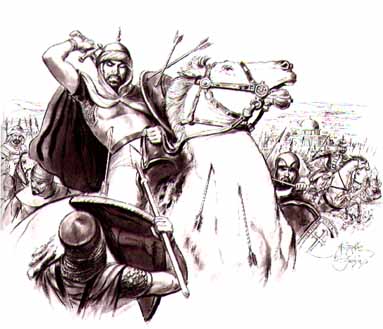
Sultan Salahuddin Yusuf bin Ayub was the founder of the Ayubi kingdom. He is one of the most famous conquerors and rulers of not only Islam but history. He was born in 1138 in Tikrit, the present-day Iraqi city. Under his leadership, the Ayub Empire ruled Egypt, Syria, Yemen, Iraq, the Hijaz and Diyarbakir. Salahuddin looks at Ayobi with courage, generosity, kindness, generosity and tolerance not only to Muslims but also to Christians. Salahuddin is said to be the conqueror of Jerusalem, who in 1187 defeated the Allied forces of Europe and liberated them from Jerusalem.

Early period:

Sultan Salahuddin was ancestor of Kurds and was born in 1138 in the part of Kurdistan which is now in Iraq. Initially, he was a military officer at Sultan Nooruddin Zangi. Salahuddin was also present in the army that conquered Egypt, and his cousin Sher Koh was Saladin's uncle. After the conquest of Egypt, Salahuddin was appointed ruler of Egypt in 564 AH. In 569 AH, they also conquered Yemen. After Nuruddin Zangi's death, Salahuddin's rule came to prominence.

Actions:

Salahuddin also took a beating of Nooruddin Zangi in his achievements. The spirit of jihad was soothed in them, and the conquest of Jerusalem was their greatest wish. After Egypt, Saladin conquered Syria, Mosul, Aleppo, and added to his empire by 1182. In the meantime, the four-year treaty with Crusader Reynold was in agreement, and both were obliged to help each other, but the deal was merely paper and formal. The crusaders were still busy in their provocations and were robbing the Muslims' caravans alike.

Battle Hutin:

In a similar attack on Christians in 1186, Reynolds insisted that Hijaz was invaded by several other Christian princes in order to attack Medina Manorah. Salahuddin Ayubi took steps to curb his activities and immediately pursued Renault and hauled him to Hatiin. Here the Sultan poured a volcanic substance on the enemy's army, causing a fire to erupt on the ground. As a result of this fierce atmosphere, 1187, at the site of Hatiin, the most horrific war of history began. Thirty thousand Christians were killed and as many prisoners as a result of this war. Reynold was arrested and the Sultan beheaded him with his hand. In fact, Renault used to bravely disgrace the Prophet Muhammad, and Sultan Ayubi vowed to kill him with his own hands. That is why he treated the ally the same as one king did with another king. But Reynold's crimes were very serious. After this war, Islamic forces invaded Christian areas.

Victory Jerusalem:

Sultan Saladin Ayubi Biography - One of the Greatest Muslim Warrior in History Sultan Saladin Ayubi
Sultan Salaudin Ayubi
After the victory of Hینtin, Salahuddin turned to Jerusalem and after a week of bloody battle, Christians surrendered and asked for mercy. After 88 years, Jerusalem was once again occupied by the Muslims, and Christianity was abolished in all of Palestine. The conquest of Jerusalem was the grand achievement of Salahuddin Ayubi. He entered the Aqsa Mosque and placed the minaret of Nuruddin Zangi in his own hand. Thus, the desire of Nooruddin Zangi was fulfilled in his hands. Salahuddin entered Jerusalem and did not commit the atrocities committed by Christian forces during the occupation of this city. Salahuddin entered Jerusalem as an ideal conqueror. He gave money to every Christian, and the poor who could not pay their money were paid by Salahuddin and his brother Malik Adil. With the victory over Jerusalem, Jerusalem's Christian government, which had been established in Palestine since 1099, ended. Soon afterwards the whole of Palestine was occupied by the Muslims. Jerusalem has been ruled by Muslims for almost 761 years. However, in 1948, with the conspiracy of the United States, Britain, France, the Jewish Empire was established in the territory of Palestine, and half of Jerusalem was occupied by the Jews. Israel occupied Jerusalem in the Arab-Israeli war of 1967.

Third Crusade:

When news of the occupation of Jerusalem arrived in Europe, all of Europe was upset. There were preparations for war on all sides. Troops from Germany, Italy, France and England began to leave for Palestine. King Richard of England, famous for his bravery, and Philip Augustus, King of France, arrived in Palestine with their own troops. Germany's United Nations army numbered 6 million, with King Frederick Barbarossa of Germany in the campaign. The Christian world had not yet provided such an infinite army. This great army left Europe and laid siege to the port of Aqa, although Sultan Salahuddin had completed all the security measures alone, but the Crusaders were constantly coming from Europe. In one case, ten thousand Christians were killed, but the Crusaders continued the siege, but because no other Islamic country extended their support to the Sultan, the blockade of the city and the Sultan was severed due to the blockade and despite the Sultan's efforts. Could not help the Muslims. Distressed, the city agreed to hand over the city to Christians on the promise of peace. An agreement was reached between the parties, according to which the Muslims promised to pay 200,000 warriors as ransom, and the Muslims surrendered, setting the conditions for the return of the Crusaders and 500 Christian prisoners. Muslims were allowed. They take all the goods out of the city, but Richard commits mischief and kills the students. After the Decade, the Crusaders turned to the Palestinian port of Askan. By the time the Ascension arrived, the Christians had fought eleven times with the Sultan, the most important being Arsov. The Sultan offered examples of courage and bravery, but no help was received from any Muslim government, especially the Caliph Baghdad. So the Sultan had to retreat. On his return, the Sultan destroyed the city of Askan himself. And when the Crusaders arrived there, they received nothing but bricks. In the meantime, the Sultan completed his defense of Jerusalem because the Crusaders were now the target of Jerusalem. The Sultan, with his small army, fought this great Lao army with great courage and courage. When no hope of victory was left, the Crusaders appealed for peace. The parties reached an agreement. Which led to the end of the Third Crusade.
The Christians of the city of Acha received nothing except the Crusade and they failed to return. Inspired by Richard Sherdall, the Sultan's generosity and bravery, the German king fled the river and died, and about six million Christians worked in these wars.

The terms of the agreement were as follows:


  • Jerusalem will still remain with the Muslims.
  • The cities of Arsov, Haifa, Jephthah, and Achka went into the hands of the Crusaders
  • Asqalan free zone was recognized.
  • Visitors are allowed to transport.
  • The Crusader remained under the control of the Muslims.
  • In the Third Crusade, Sultan Salahuddin proved that he was the most powerful ruler in the world.

Character:

Salahuddin was very brave and generous. They treated Christians so well in battle that Christians still respect them. They were so fond of jihad that once they fell into their lower torso they could not sit and eat. But even in this case the activity of jihad did not differ. From dawn to dusk, and from ash to west, they lived on horseback. They were surprised and said that as long as I stay on the horse's back all the pain goes away and when I get off of it, the pain starts again. After reconciliation with the Christians, Salahuddin allowed Christians to visit the temple. The European visitors, who had been waiting for years for permission, broke out so often that it was difficult for King Richard to maintain order and he told the Sultan that he could write to anyone in Jerusalem without his permission and permission. Don't enter The Sultan replied, "It is not proper to stop the pilgrims from coming to the fountain of pilgrimage. Not only did the Sultan give these visitors all kinds of freedom but he also arranged the orbit, relief, comfort and invitation of millions of visitors on his behalf. Salahuddin's treatment of non-Muslims was in accordance with the same Islamic teachings, and this is proof that the rights of non-Muslims are protected in the Islamic government in the same way as Muslims. Like Nooruddin, Saladin's life was simple. Never used silk cloth and the place of residence was a modest house. The Sultan was a true and pious Muslim.

Public works:

When you inspected the palaces of the Fatimid rulers after the capture of Cairo, there were numerous gems and gold and silver utensils. Instead of taking it all in his possession, Salahuddin put it in the Baithamal. The palaces were put to general use and a magnificent monastery was established in a palace. Seminaries were not established in the time of the Fatimids In the days of Nooruddin Zangi, madrassas and clinics were established in Syria, but Egypt was still deprived. Salahuddin often established madrassas and clinics here. In these madrassas, the students' reception was also managed by the government. Ibn Jabir, a tourist about Salahuddin's hospital in Cairo, writes that the sanctuary is known as a palace in which a lot of medicine is available. Great storage. It also mentions the women's sanctuary and the madhouse. Salahuddin was the contemporary of the Ghorian ruler Shahabuddin Ghori and Moroccan ruler Yakub al-Mansour, and was undoubtedly one of the greatest rulers of the world in his time.

Died:

Sultan Saladin Ayubi Biography - One of the Greatest Muslim Warrior in History Sultan Saladin Ayubi
The shrine of Salahuddin, adjoining
the mosque of Umayyad
Salahuddin died in 589 AH. It was buried in the outskirts of the current Syrian capital, Umayyad. Salahuddin ruled for 20 years. According to historian Ibn Khalakhan, the day of his death was so painful that such a tragic day never came after the death of the Caliph Rashidin on Islam and Muslims. Len Paul, an English historian of the present era, also praises the sultan, and writes that there was a strange difference between his contemporaries and the kings. The kings earned honor because of their glory and love of the people and interest in their affairs earned the wealth of all sorts of honor. The government formed by Salahuddin Ayubi was called "Ayubi" by his father Najmuddin Ayub. Although Saladin was a wise and capable ruler, he could not free himself from the traditional ideas. The true concept of the Khilafah was now forgotten by Muslim society to such an extent that rulers like Nooruddin and Salahuddin also thought in terms of belonging. In the matter of succession, Salahuddin made the same mistake that Haroon al-Rashid had done in the first place, and since the Salajuqis all rulers have been doing so. He divided his kingdom into three boys, under the mistaken custom of the times. As a result, the powerful empire was divided and weakened. Yet some of the worthy rulers of the Ayubi family, including Salahuddin's brother Malik Adil and his son Malik, are notable, keeping Egypt, Syria, Hijaz and Yemen largely united for nearly 60 years. In 648 AH, the rule of the Ayubi family was abolished and replaced by a Turkish slave government called Mamluk.

Bhagat Singh March 23 --- 23 March Bhagat Singh

March 22, 2020

Bhagat Singh March 23 --- 23 March Bhagat Singh

Bhagat Singh:

Bhagat Singh March 23 --- 23 March Bhagat Singh(1907 to March 23, 1931) The hero of the struggle for independence in the subcontinent. Bhagat Singh was a supporter of the socialist revolution. Indian society at the level of class-free equality was wanted. Born in Mouza Banga in Lyallpur district. Ajit Singh was h
is uncle on the Kama Gata ship. The Jallianwala Bagh massacre and non-cooperation movement accepted the bloodshed. He left school in 1921 and began his education at the National College. In 1927, Lahore was arrested in connection with the Dussehra bomb case and the royal fort was kept in Lahore. After being released on bail, the young Indians formed the Sabha and then joined the revolutionaries. At the same time as the Central Assembly was meeting in Delhi, he and Bay Dutt threw explosives at the Assembly Hall. Both were arrested. Court sentences life imprisonment On the arrival of the Simon Commission in 1928, there was a strong protest at the Lahore Railway Station. Police charged the baton in which Lala Lajpat Rai was injured. The then superintendent of police at Lahore was Mr Scott. The revolutionaries planned to kill them. But one day when Mr Sanders Assistant Superintendent of Police left Lahore from his office on a motorcycle, Shiv Ram Raj Guru and Bhagat Singh, etc., shot and killed him. Havdar Jain followed Singh. They also shot him and changed clothes at the DAV college hostel. Finally, Khan Bahadur Sheikh Abdul Aziz arrested all the revolutionaries in the Kashmir Building Lahore one night. He was tried in the Lahore Central Jail Room Court. Bhagat Singh and Dutt had earlier been convicted in the assembly bomb case. The trial lasted for three years. Khan Sahib Qalandar Ali Khan on behalf of the government and Lala Amar on behalf of the accused were senior lawyers. Bhagat Singh and Sikh Dev were sentenced to death and hanged on March 23, 1931. On the banks of the river Sutlej near Ferozepur, their bodies were burnt. Later, his memorial was erected here....